The Token Maxxer asks how much can be produced. The Token Master asks what deserves to be produced.
Imagine two founders with access to the same models, coding agents, design tools, and token budget.
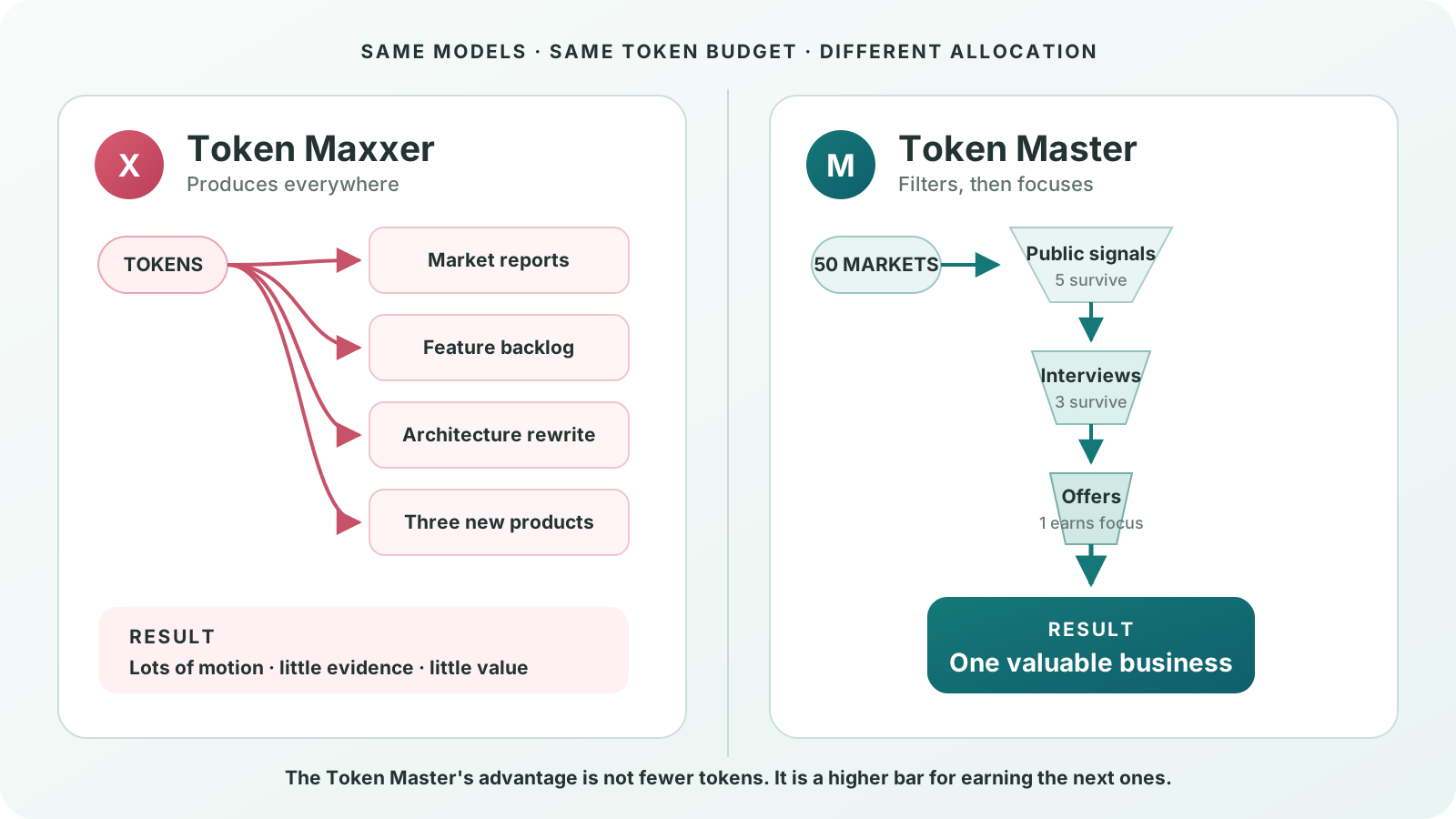
The Token Maxxer launches agents in every direction. They generate market reports, rewrite the architecture, create dozens of landing pages, polish onboarding, debate naming, refactor the database, and start several products at once. After a year, the Maxxer has produced an extraordinary amount of work and very little value.
The Token Master investigates 50 markets, rejects 45 quickly, speaks with customers in the remaining five, tests three offers, and finds one people will pay for. Only then do they build. After a year, the Master has produced much less software and a much more valuable business.
The Token Master has achieved a far better token-to-revenue conversion.
This does not mean we should literally count every token used during research, coding, design, and background agent work. Attribution would be messy and often false.
Revenue per token is more useful as a thought experiment:
How effectively can a person convert abundant machine intelligence into scarce real-world value?
For a company, that value often appears as revenue. For a scientist it might be a discovery. For an artist, a meaningful work. For a government, a solved public problem.
Revenue per token is the capitalist version of a broader idea: intelligence efficiency.
Production is cheap. Judgment is not.
AI can research markets, write code, generate interfaces, create advertising concepts, analyze feedback, draft sales emails, and operate parts of a product. What it does not remove is the need to decide:
- Which problem matters?
- Which customer should we serve?
- Which evidence should we trust?
- Which experiment should we run?
- Which feature should we reject?
- When should we stop?
- How will the product reach people?
- What deserves another million tokens?
As machine intelligence becomes more abundant, allocation becomes more valuable than generation. The scarce capability is no longer merely producing an answer. It is knowing which questions deserve to be answered.
A useful mental model is:
Token leverage ≈ problem quality × evidence quality × execution discipline × distribution × reuse
This is not an accounting formula. It is deliberately multiplicative: a beautifully built product multiplied by zero demand still produces approximately zero value.
Token-maxxer culture
Token maxxing is the natural posture of an era in which machine intelligence suddenly feels abundant. Models improve every few months, agents work in parallel, and another experiment costs almost nothing compared with hiring a team.
At its best, this culture is a useful rejection of artificial scarcity. You learn agents by using them. Running ten cheap experiments can be more rational than debating one idea for a month. A founder who refuses to spend tokens may be protecting pennies while competitors buy information.
The problem begins when token burn becomes a status signal.
The Maxxer posts screenshots of 30 agents running at once. They celebrate lines of code, prompts executed, apps launched, and billions of tokens consumed. Their default question is “What else can we generate?” The activity is real, impressive, and increasingly disconnected from an external result.
Token-maxxer culture tends to confuse:
- compute with conviction;
- parallelism with strategy;
- output with outcomes;
- novelty with demand;
- autonomy with the absence of oversight;
- a full context window with a clear mind.
The seduction is powerful because AI can make every branch look finished. Ten weak ideas can return with research, branding, architecture, and polished prototypes. The presentation quality conceals that no customer has changed their behavior.
The Token Master may ultimately spend more tokens than the Maxxer. The difference is not restraint for its own sake. It is gated allocation: each new tranche of intelligence must earn its way through evidence, commitment, or measured performance.
The Maxxer spends because tokens are available. The Master spends because the next question is worth answering.
The Token Master does not minimize tokens
Revenue per token should not become an argument for using as little AI as possible.
A company should not minimize employee hours. An investor should not minimize invested capital. They should allocate those resources where the expected return is greatest. The same applies to tokens.
Spending another 100 million tokens can be an excellent decision if it uncovers a valuable market, resolves a critical technical risk, or creates a distribution system that repeatedly attracts customers.
It is wasteful when those tokens produce:
- a more elegant settings screen nobody needs;
- a fourth architecture rewrite;
- another speculative market report;
- 200 feature ideas without customer evidence;
- a complete product before anyone commits to using it;
- an agent loop with no budget or stopping condition.
The goal is not minimum token consumption. It is maximum consequential progress per unit of machine intelligence.
Token Maxxer and Token Master
| Token Maxxer | Token Master |
|---|---|
| Starts with a product idea | Starts with a customer situation |
| Uses AI to confirm the idea | Uses AI to find reasons it may fail |
| Measures output | Measures evidence |
| Builds before selling | Seeks commitment before building |
| Runs open-ended agent loops | Gives agents budgets and stop conditions |
| Adds features to create value | Removes uncertainty to discover value |
| Pursues several active ideas | Maintains one active bet |
| Treats distribution as a launch task | Designs distribution with the product |
| Interprets compliments as validation | Looks for behavior, sacrifice, and payment |
| Sees killed projects as failure | Sees cheap rejection as progress |
The biggest difference is that the Token Master has a much higher idea mortality rate.
That sounds negative, but it is a superpower. The Master does not protect ideas. They protect time, attention, and future opportunity.
The Token Master operating system
1. Choose an arena, then set an appetite
The Maxxer begins with: “I want to build an AI plant app.”
The Master begins with: “Which recurring gardening problems cause balcony owners to lose plants, spend money, or abandon the hobby?”
The first framing already contains a solution. The second opens an opportunity space.
Start with a specific group, a recurring situation, and an expensive, frustrating, or emotionally important outcome. Look for the trigger that makes the problem urgent and the reason existing options fail.
Then decide how much the opportunity is worth before excitement expands the project:
I will spend one week researching this market, speak with at least five qualified people, and spend no more than two days on a prototype before deciding whether to continue.
Basecamp’s Shape Up calls this an appetite: start with a time budget and design the work to fit it. It is the opposite of allowing an idea to silently become a three-month project.
2. Keep an opportunity ledger, not an idea list
“AI meal planner for students” is an idea.
“Engineering students living alone repeatedly buy groceries without a plan, throw food away, and want a cheap weekly menu” is an opportunity hypothesis. It contains claims that can be tested.
For each opportunity, record:
| Field | Question |
|---|---|
| Customer | Who experiences this? |
| Trigger | When does the problem become urgent? |
| Current behavior | What do they do today? |
| Consequence | What happens when it goes badly? |
| Existing spend | What money or labor is already used? |
| Buyer | Who can approve a purchase? |
| Evidence | Where did this information come from? |
| Access | Can I reach the first 20 prospects? |
| Next test | What is the cheapest way to learn more? |
| Kill condition | What result would make me stop? |
AI is excellent at expanding and compressing this search. Use it to find repeated complaints, expensive manual workflows, spreadsheets acting as informal software, regulatory changes, unloved incumbents, and disconnected tools people already pay for.
But keep three categories separate:
- Model-generated hypothesis — a plausible lead.
- Public signal — evidence that someone described the problem.
- Observed behavior — evidence of what a customer actually does, sacrifices, or buys.
They are not equally strong. AI should produce leads for contact with reality, not replace that contact.
A better research prompt is:
Investigate this market as a skeptical analyst. Identify repeated problems, current workarounds, existing spending, purchasing triggers, incumbent products, and reasons a new entrant may fail. Separate sourced facts from interpretations and unknowns. Do not generate product features. End with the five assumptions that most urgently require direct customer evidence.
3. Rank uncertainty, not excitement
A simple score can expose why one opportunity is stronger than another:
Opportunity quality ≈ (pain × frequency × existing spend × reachability × founder advantage) ÷ (behavior change × sales friction × solution risk)
Score each factor from one to five. The result is not objective truth. Its job is to surface disagreements and weak assumptions.
Then identify the dominant risk. Silicon Valley Product Group separates product risk into value, usability, feasibility, and business viability. Ask which one could kill the idea now, and choose an experiment that targets it.
This avoids a common error: using a technical prototype to answer a demand question. A functioning prototype proves that something can be built. It does not prove that anyone wants it.
4. Interview for stories, not opinions
Weak research asks:
Would you use an AI tool that automatically solved this?
The respondent imagines an ideal future, wants to be helpful, and says yes.
Strong research asks about the past:
- Tell me about the last time this happened.
- What triggered it?
- What did you do first?
- What happened next?
- Which part was most difficult?
- What did the failure cost?
- What have you already tried?
- Could you show me how you do it today?
- Who would need to approve a purchase?
- When did you last pay for something intended to solve this?
Concrete stories reveal context and behavior. Opinions mostly reveal what people would like to believe about themselves.
Listen for evidence of frequency, urgency, workarounds, budget, authority, and failed alternatives. Do not turn interviews into feature-voting sessions. Customers are experts in their situation; you are still responsible for designing the response.
5. Climb the commitment ladder
Not all validation is equal. A stranger saying “that sounds useful” is evidence, but weak evidence. Someone giving you access to their workflow is stronger. Someone paying is stronger still.
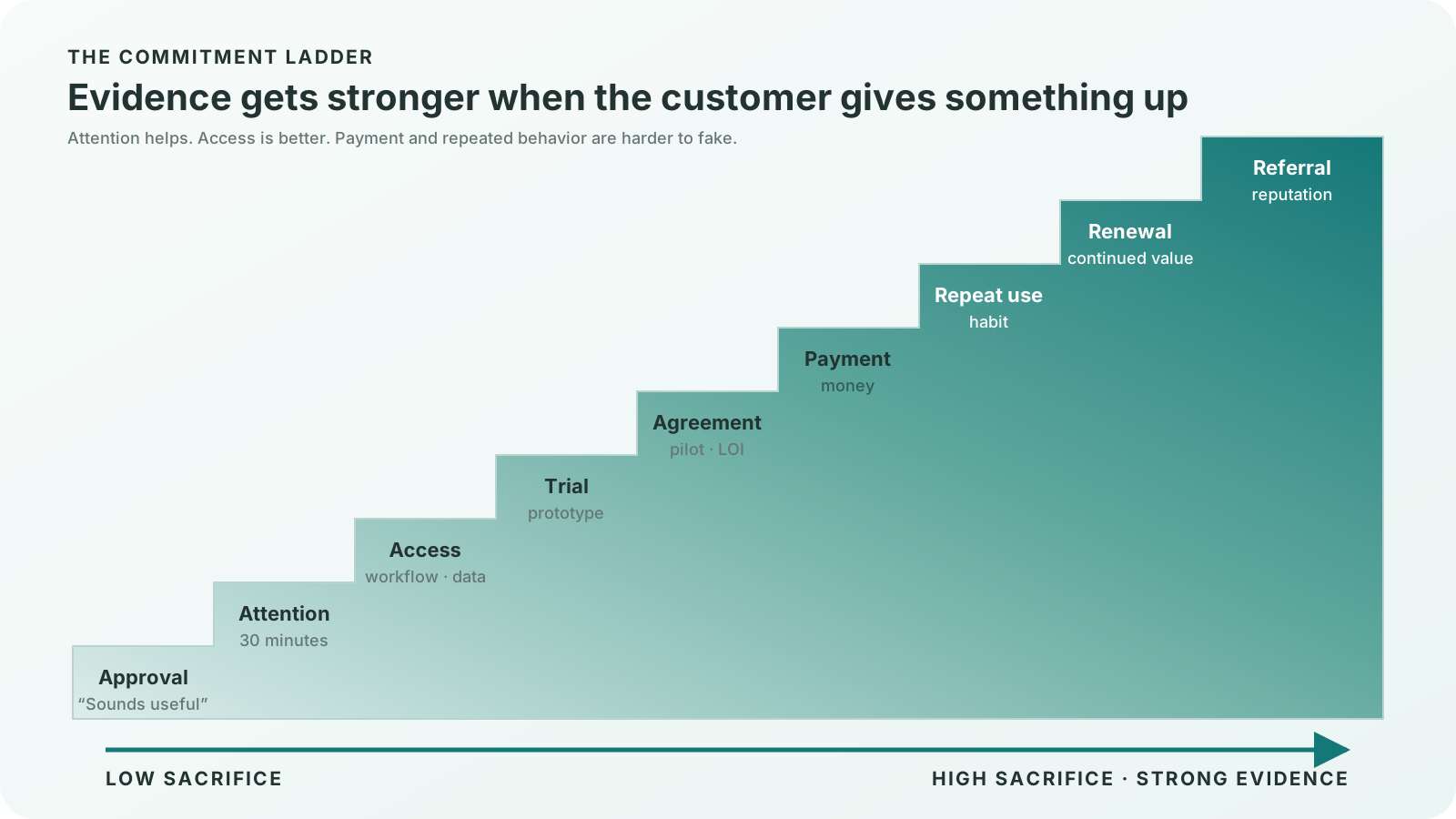
Possible tests include targeted outreach, a precise landing page, a clickable prototype, a concierge service, a refundable deposit, a paid pilot, a preorder, or a design-partner agreement.
Not every product can collect payment before development. Games, consumer entertainment, and network products often need different tests. But every project should seek the strongest feasible form of commitment.
The difference between a waitlist and a payment link is not technical complexity. It is evidential strength.
6. Build to learn, with an agent contract
An MVP is not a small version of the complete product. It is the smallest artifact capable of answering the most important unanswered question.
- If the risk is usability, create a clickable prototype.
- If the risk is model reliability, create a narrow benchmark.
- If the risk is willingness to pay, sell a manual service.
- If the risk is time saved, run the workflow manually for three customers and measure it.
- If the risk is retention, build only the recurring core loop.
Modern agents make prototypes extraordinarily cheap. That creates a new danger: because building is easy, founders use building to avoid selling.
The purpose of the first build is not to prove that the founder can build. It is to make reality answer a question.
Every agent should also receive a contract:
| Contract field | Question |
|---|---|
| Decision | What decision will this work help us make? |
| Evidence | What customer data and prior results should it use? |
| Scope | What is included and explicitly excluded? |
| Appetite | How much time or iteration is justified? |
| Deliverable | What concrete artifact should exist? |
| Verification | Which tests or criteria determine success? |
| Stop condition | When must the agent stop or escalate? |
OpenAI’s account of agent-first engineering makes the same shift visible at software scale: humans increasingly design environments, specify intent, and create feedback loops in which agents can work reliably. Autonomy becomes useful when the harness is good.
7. Design distribution before finishing the product
A product without a credible path to customers may be an entire business model away from success.
Before serious development, answer:
- Where do these customers already gather?
- What do they search for?
- Can I name and reach the first 50 prospects?
- Who already has their trust?
- Is there an integration, marketplace, consultant, or reseller that can distribute this?
- Does the product create an output people naturally share?
- Is there a regulatory, seasonal, or organizational trigger for buying?
For an early B2B product, founder-led outreach is not an embarrassing temporary tactic. It is a learning channel. Sales conversations reveal language, urgency, objections, authority, budget, and implementation risk.
The Token Master tries to sell the outcome while the product is still cheap to change.
8. Measure outcomes, then count tokens
Once people use the product, the evidence changes again. Track activation, successful task completion, repeat usage, retention, paid conversion, expansion, referral, support burden, and gross margin.
For an AI product, add model and prompt version, token use, cost, latency, retries, failure category, user feedback, and regressions. Tools such as Langfuse can connect traces to tokens, cost, latency, prompts, and evaluations.
This is where literal token measurement becomes useful—but at the level of a workflow, not as a grand founder score. Useful operating metrics include:
- cost per successful customer outcome;
- gross margin per AI-assisted workflow;
- tokens per activated or retained user;
- failure and retry rate by model or prompt version;
- revenue retained after model cost and support burden.
Do not optimize a cheap failure. A workflow that costs half as much but causes twice as many retries has worse intelligence efficiency.
A weekly Token Master review
Once a week, stop the agents and review the portfolio:
- What did we learn? Name the evidence, not the output.
- Which assumption became safer or more dangerous? Update the ledger.
- What did a customer commit? Separate praise from sacrifice.
- What should die? Close weak bets before opening new ones.
- What is the single active bet? Concentrate execution.
- What is the next cheapest decisive test? Give it an appetite and a stop condition.
This review is the control surface for abundant intelligence. Without it, output compounds faster than understanding.
The founder’s job moves upstream
When code, copy, analysis, and design were expensive, producing them was evidence of progress. That shortcut no longer works.
AI can make a weak decision look finished. It can add polish before proof, scale a misunderstanding, and generate enough motion to hide the absence of demand.
The Token Master resists that seduction. They use machine intelligence aggressively, but place it behind a sequence of increasingly expensive gates:
hypothesis → public signal → customer story → commitment → build → behavior → revenue
The future will contain far more software, campaigns, research, and content than today. Most of it will be easy to produce. The valuable work will come from people who are unusually good at choosing the right problem, demanding evidence, killing weak ideas, concentrating resources, and reaching customers.
The winning founder will not ask, “How much can these agents make?”
They will ask:
What is the most valuable thing reality is ready to let us prove next?
AI-boosted Georgi: This post was written with AI as an experiment—and because a busy family man has more ideas than uninterrupted writing time. The experience, opinions, and final editorial decisions are mine.