Last year, we bought an apartment, and one of my dreams was to turn the living room into a home theater. I am a huge movie geek, so naturally it was one of the first things I worked on after we moved in. Building it, tuning it, and hearing it come together has been an amazing experience.
This post covers the complete setup: the exact speakers and equipment, what I paid, how everything is positioned, and how I calibrated it. I have also included a collection of movie scenes and timestamps for testing surround sound, gathered over a year of skipping through films in search of the best moments, plus a Spotify playlist for putting a system through its musical paces.
TL;DR: I love this setup. Movies and music still amaze me, and I keep discovering details I had never heard before. If I changed anything in the future, I would add a suspended ceiling with in-ceiling Atmos speakers instead of the Polks and upgrade to a laser projector.
The difficult part was not buying nine speakers. It was fitting them into a real room, then calibrating them until they stopped sounding like separate boxes.
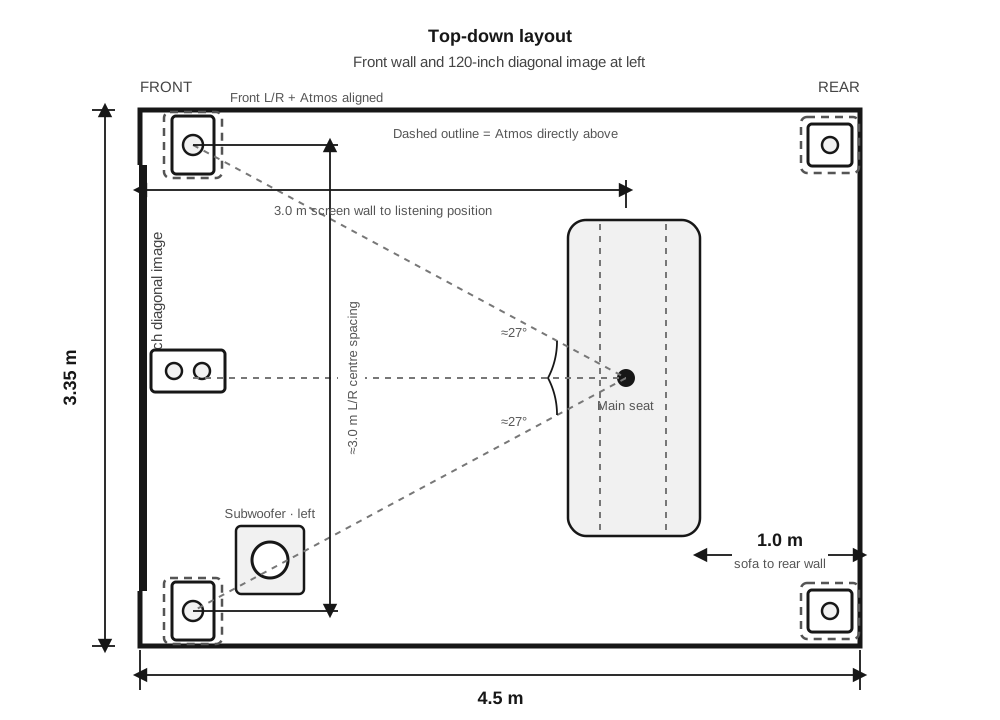
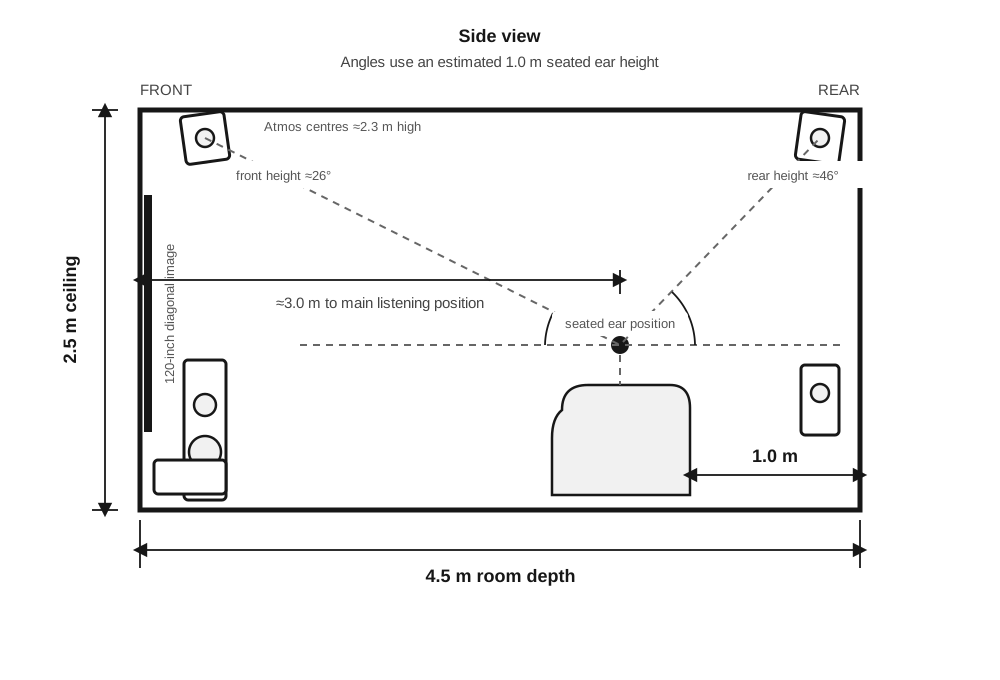
The room is roughly 4.5 × 3.35 × 2.5 metres. The main seat is about three metres from a 120-inch projected image, and the sofa is about one metre forward of the rear wall.
It is a living room, not a purpose-built cinema. Furniture, cable routes, and the ceiling determined what was practical. The principle that survived all the research was simple:
The goal is not to build the theoretically perfect system. It is to build the best system your room allows, then calibrate it properly.
The result is a 5.1.4 Dolby Atmos system built around ELAC front speakers, six compact Polks, an Onkyo receiver with Dirac Live, and a dedicated subwoofer.
The final system
A 5.1.4 system has five ear-level channels, one subwoofer, and four height channels. These are the prices I actually paid:
| Role | Component | Approx. price |
|---|---|---|
| Front left/right | ELAC Debut Reference DBR62 | €400 |
| Center | ELAC Uni-Fi 2.0 UC52 | €250 |
| Surrounds | 2× Polk Signature Elite ES10 | included below |
| Front heights | 2× Polk Signature Elite ES10 | included below |
| Rear heights | 2× Polk Signature Elite ES10 | ~€500 for all six Polk speakers |
| AV receiver | Onkyo TX-NR7100 with Dirac Live | €900 |
| Subwoofer | Mivoc Hype 10 G2 | €200 |
| Streaming | Nvidia Shield | €220 |
The 5.1.4 audio system itself came to roughly €2,300. The Shield and projector are separate.
Why I chose the ELAC front stage
The center carries most dialogue and anchors sound to the image, so I spent more attention on it than I first expected. I chose the ELAC Uni-Fi 2.0 UC52, a three-way center with a concentric midrange/tweeter. The two references I used most were Erin’s Audio Corner review and the Audio Science Review discussion of Erin’s measurements.
For left and right I chose ELAC Debut Reference DBR62 bookshelf speakers. With a subwoofer and bass management, towers did not make sense in a roughly 15 m² room. Audio Science Review’s DBR62 measurements and listening review reinforced that choice:
“The ELAC DBR-62 objectively and subjectively meets and exceeds my expectations. It is ‘high-end’ sound on a budget with little to apologize for.”
The reviewer also wrote that he was reluctant to stop listening long enough to finish the review. That matched why I kept returning to the DBR62.
Why six compact Polk speakers and 5.1.4
The surrounds and all four height channels are Polk Signature Elite ES10s. Their small cabinets and built-in mounting options let me place six speakers without turning the room into a studio. I wanted real height speakers just below the ceiling, not upward-firing modules.
With nine amplified channels, the receiver made me choose between 7.1.2 and 5.1.4. I chose four height channels because they create a front-to-back overhead field; two heights can tell me that something is above, but four can show it moving across the room.
The room in plan and section
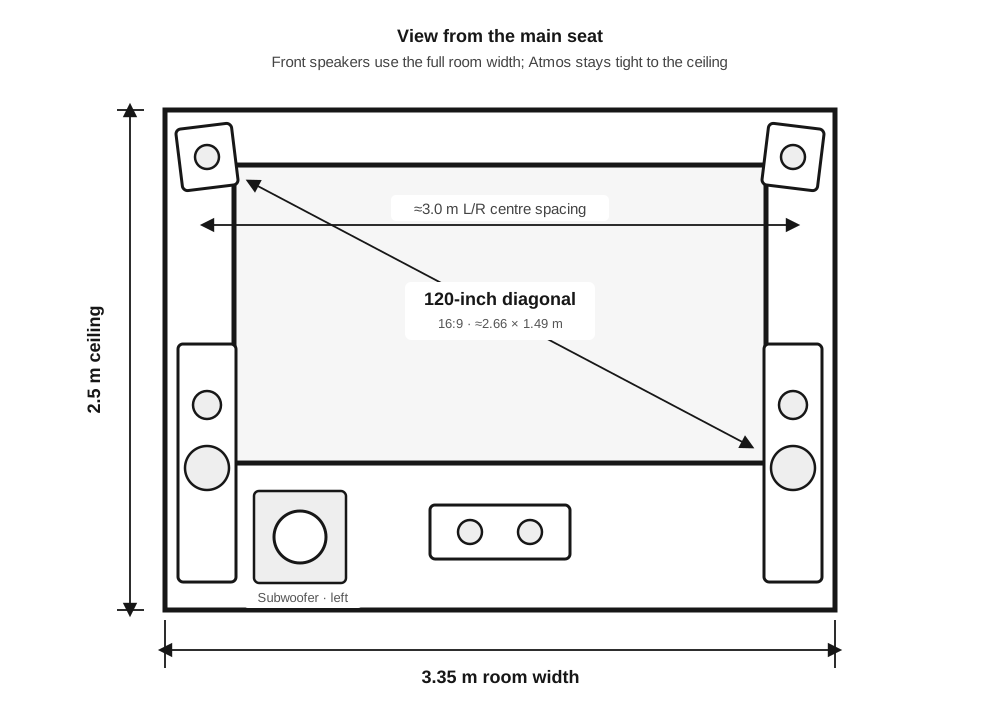
These are dimensioned layout drawings, not an as-built CAD survey. The room, screen, listening distance, and sofa clearance are measured. The angle guide assumes a seated ear height of about 1.0 m and Atmos speaker centres around 2.3 m, so those two values remain estimates until I measure the installed centres precisely.
The placement compromise
The sofa sits about one metre from the rear wall. The left and right speakers use almost the full room width, while all four Atmos speakers are mounted immediately below the ceiling. The front pair is high on the front wall rather than cut into the ceiling; the rear pair sits behind the listening position.
That is not textbook Top Front placement. It is closer to the Front High + Top Rear layout supported by the Onkyo TX-NR7100. Dolby’s installation guide remains the reference, but the room made a compromise necessary.
The important result is clear vertical separation: ear-level surrounds, plus a distinct layer overhead. The front heights extend the screen upward and the rear pair makes movement over the sofa convincing.
Dirac Live and calibration
Dirac Live was one of the main reasons I chose the Onkyo. Dirac Live Room Correction aligns level, timing, and frequency response across the listening area. In this room it improved dialogue focus, bass integration, and movement between speakers.
My calibration routine is short:
- Put the first microphone position at seated ear height in the main seat.
- Cluster the remaining measurements around the sofa, not around the whole room.
- Keep the microphone still and the room quiet.
- Use a target curve with a little bass lift instead of forcing everything ruler-flat.
Room correction cannot repair bad placement. I move and aim the speakers first, then calibrate.
The projector and the next upgrade
The ViewSonic PX701HD has been good: bright, dependable, and capable of producing the 120-inch Full HD image that shaped the rest of the system. Mine is old now and has used roughly 70% of its bulb life.
For version 2, I am considering a suspended ceiling with built-in speakers replacing the four wall-mounted Polk height speakers. I would also upgrade the projector, possibly to a model in the XGIMI HORIZON 20 series, and may add a nicer fixed screen. A better subwoofer is the other obvious upgrade, but the current system is already balanced enough that none of these changes is urgent or final yet.
What mattered most
- The center speaker matters more than I expected.
- Four height channels were worth choosing over two extra rear surrounds.
- Compact speakers made a real 5.1.4 layout practical in a living room.
- Placement and calibration improved the system more than oversized front speakers would have.
What to watch: lossless audio, Blu-ray, and streaming
An Atmos or DTS:X badge describes the immersive format, not necessarily the audio quality underneath it. Atmos can be delivered in lossless Dolby TrueHD on a disc or in lossy Dolby Digital Plus on a streaming service. Dolby’s own format comparison lists Dolby Digital Plus as lossy and Dolby TrueHD as lossless; similarly, DTS-HD Master Audio is a lossless format, and disc-based DTS:X can use a lossless master-audio stream.
My order of preference is:
| Source | Audio to look for | What you get |
|---|---|---|
| 4K UHD Blu-ray or Blu-ray | Dolby TrueHD/Atmos, DTS-HD Master Audio/DTS:X, or multichannel LPCM | Usually the best practical source: lossless audio with no dependence on streaming bandwidth. Check the disc, because not every release or language track uses the same format. |
| A direct-play copy of a disc I own | The unchanged TrueHD, DTS-HD Master Audio, or LPCM track | Disc-quality sound without handling the disc, provided the server and player do not transcode it. The Nvidia Shield TV Pro can pass through TrueHD, DTS-HD, Atmos, and DTS:X over HDMI, which is one reason it fits this system so well. |
| Kaleidescape movie download | TrueHD/Atmos or DTS-HD Master Audio/DTS:X | Actual lossless digital delivery, but through a very expensive dedicated player and storage ecosystem. Kaleidescape says its downloads include lossless soundtracks; this is a download-first system, not normal adaptive streaming. |
| Mainstream movie streaming | Usually Dolby Digital Plus 5.1 or Dolby Digital Plus with Atmos | Convenient and often very good, but lossy. A premium tier may unlock Atmos without making the soundtrack lossless. |
That last distinction matters when choosing a subscription. Netflix requires a plan that supports Ultra HD for Atmos, Disney+ reserves Atmos for its Premium plan, Max puts Atmos on Premium, and Prime Video may require its Ad Free option for Dolby Atmos on supported titles. Apple TV+ and Apple movie rentals also offer Atmos on compatible devices. These services are useful ways to get an Atmos mix, but none of those labels means Dolby TrueHD or DTS-HD Master Audio. Sony Pictures Core is another interesting middle ground: its Pure Stream mode reaches up to 80 Mbps and supports Atmos and DTS:X, but Sony advertises that bitrate for picture quality and does not claim lossless movie audio.
How much difference does lossless audio make?
On this system, the difference is real but not equally obvious in every scene. In quiet dialogue, a well-encoded stream can sound extremely close. The advantage becomes easier to hear during dense action, music, sharp transients, and deep bass: a good disc track tends to feel less constrained, with more impact, cleaner separation, and more low-level ambience around the room.
The codec is not the only variable. A disc and a stream can use different mixes, levels, or dynamic-range processing, and those changes may be more audible than the compression itself. Lossless audio also cannot rescue a mediocre mix. For a fair comparison I match the volume as closely as possible and disable night mode or dynamic-range compression.
My practical rule is simple: stream casually, but use Blu-ray or UHD Blu-ray for favourite films, serious listening, and demo scenes. Lossless sound is worthwhile on a calibrated 5.1.4 system, but it is the final layer of polish after speaker placement, room correction, and the quality of the original mix.
Movie demo reference: scenes and timestamps
Whenever I change the calibration, move a speaker, or want to demonstrate the system, I return to the same scenes. This is my quick-reference list for choosing a test by timestamp and by the part of the system I want to hear. Timestamps can shift by a minute or two between editions and cuts.
| Movie | Timestamp(s) | What I listen for |
|---|---|---|
| Ready Player One | 0:20, 1:36 | Racing and battle sequences with strong 360-degree movement |
| War of the Worlds | 0:20, 1:05 | Extreme low end, environmental destruction, and scale |
| Mad Max: Fury Road | Intro, 0:16, 0:20, 0:27 | Engines, vehicles, impacts, and constant directional motion |
| Interstellar | 1:00, 2:10, 2:17 | Organ, dynamics, spacecraft, bass, and an enormous soundstage |
| 1917 | 0:27, 1:07 | Environmental ambience, transitions, and explosive dynamics |
| Top Gun: Maverick | 1:35 | Jets, engine weight, aggressive panning, and height information |
| Blade Runner 2049 | 0:13, 0:20, 0:43, 0:58, 2:18 | Huge low end, electronic score, ambience, and room scale |
| Dunkirk | 0:06, 0:15, 0:35, 0:38, 1:12, 1:18, 1:23 | Aircraft, gunfire, tension, dynamics, and directionality |
| The Matrix | 1:45, 1:54 | Gunfire, bullet movement, impacts, and surround panning |
| Dune | 1:05 | Massive bass, scale, machinery, and score |
| Dune: Part Two | 0:54, 2:00, 2:13 | Sand, war, huge dynamics, and low-frequency energy |
| The Lost World: Jurassic Park | 1:05, 1:20, 1:50 | Dinosaurs, jungle atmosphere, impact, and low-frequency effects |
| Saving Private Ryan | 0:07 | Chaotic surround placement during the Omaha Beach sequence |
| Tenet | 0:40, 1:15, 1:30 | Bass, score, movement, and deliberately overwhelming dynamics |
| The Lord of the Rings: The Two Towers | 2:48 | Battle scale, crowds, score, and the surround field |
| The Matrix Reloaded | 1:30 | Freeway action, vehicle movement, and aggressive panning |
| Edge of Tomorrow | 0:17, 1:08 | Battlefield chaos, machinery, and explosions |
| The Lord of the Rings: The Return of the King | 1:56, 2:04, 2:20, 2:31, 2:40 | Battles, cavalry, creatures, score, and scale |
| Sinners | 0:55, 1:16, 1:35, 1:47 | Music, dynamics, atmosphere, and spatial detail |
| Tron: Ares | 0:03, 0:36, 0:58 | Electronic score, bass, and a wide synthetic soundstage |
| Inception | 0:09, 0:27, 1:05 | Bass hits, environmental destruction, and score |
| The Dark Knight | 1:15 | Dynamics, vehicles, impacts, and score |
| Superman | 0:30, 1:05 | Flight, action, score, and height effects |
| Harry Potter and the Goblet of Fire | 0:58, 1:12, 1:30 | Magical effects, creatures, ambience, and score |
| Alita: Battle Angel | 1:00 | Fast action, metallic effects, and bass |
| Alien: Romulus | 1:28 | Spacecraft ambience, machinery, and positional effects |
| Gravity | 0:45, 1:09 | Three-dimensional positioning and movement |
| Indiana Jones and the Temple of Doom | 1:35 | Action, movement, and classic adventure mixing |
| Transformers: The Last Knight | 0:53, 2:04 | Mechanical detail, huge impacts, and bass |
| Twisters | 1:00, 1:45 | Wind, debris, overhead movement, and bass |
| Furiosa: A Mad Max Saga | 1:05 | Engines, chase dynamics, and physical low end |
| Transformers: Age of Extinction | 1:18, 2:15 | Metallic impacts, explosions, and enormous scale |
| Avengers: Endgame | 2:18 | Final-battle scale, music, surrounds, and bass |
| Mission: Impossible | 0:27, 1:35 | Action, movement, and dynamics |
| A Quiet Place | 0:55 | Micro-detail, silence, and spatial positioning |
| Godzilla Minus One | 0:55 | Monster scale, impact, destruction, and low-frequency effects |
| Pacific Rim | 1:18 | Giant machines, giant monsters, impact, and scale |
| Spider-Man: Into the Spider-Verse | 1:04, 1:40 | Music, effects, width, and fast transitions |
| 300 | 0:45 | Stylized battle effects, impacts, and dynamics |
| Oppenheimer | 0:08 | Dynamic contrast, score, and low-frequency energy |
| Rogue One | 0:47, 1:38 | Spacecraft, lasers, battle movement, and score |
| Nope | 1:20 | Wide environmental sound and movement through the room |
| Hacksaw Ridge | 1:32 | Battlefield chaos, gunfire, explosions, and surrounds |
Some scenes are better recorded than others. That is not really the point. These are the ones that made me stop and think: this is why I installed nine speakers.
Music test reference: 48 tracks from my playlist
Movies tell me whether the system can create scale. Music tells me whether it is actually good.
With a familiar recording, I listen for whether the center image stays locked in place, vocals have realistic size, instruments remain separated, bass has definition, transients have impact, cymbals become harsh, reverberation decays naturally, and the speakers disappear. I picked these 48 tracks from the 112-song Speaker Test playlist because together they cover those jobs without becoming a nine-hour test session.
The number in the first column is the track’s position in the full playlist.
| # | Track | Artist | What I listen for |
|---|---|---|---|
| 45 | Bubbles | Yosi Horikawa | Precise object placement, depth, height cues, and transient realism |
| 112 | Chocolate Chip Trip | Tool | Drum-kit positioning, huge transient swings, low-end impact, and room scale |
| 25 | Keith Don’t Go | Nils Lofgren | Acoustic-guitar transients, speed, string detail, and crowd ambience |
| 1 | Roxane | Petra Magoni, Ferruccio Spinetti | Vocal presence, upright-bass texture, and the space of the live room |
| 2 | Sympathy for the Devil | The Rolling Stones | Percussion placement, the gradual build, and separation as the mix fills up |
| 3 | Get Lucky | Daft Punk, Pharrell Williams, Nile Rodgers | Kick definition, rhythm-guitar transients, groove, and polished top-end detail |
| 5 | Little Wing | Jimi Hendrix | Guitar texture, image placement, and whether the upper mids become aggressive |
| 6 | High by the Beach | Lana Del Rey | Deep synthesized bass beneath an airy, layered vocal |
| 7 | Keep the Streets Empty for Me | Fever Ray | Low-level ambience, vocal focus, and a dark soundstage that should stay open |
| 8 | My Home Is in the Delta | Muddy Waters | Natural voice and guitar tone, body, and the recorded room |
| 10 | Chan Chan | Buena Vista Social Club | Acoustic imaging, percussion layers, and convincing instrument scale |
| 11 | Long After You’re Gone | Chris Jones, Steve Baker | Male vocal weight, guitar resonance, and sharply placed harmonica |
| 12 | All Your Love (Turned to Passion) | Sara K. | Vocal intimacy, acoustic attack, and clean decay |
| 14 | Brothers in Arms | Club for Five | Five-part vocal separation, center stability, and bass-vocal extension |
| 15 | Beatles’ Medley | Tommy Emmanuel | Fingerstyle speed, string attack, dynamics, and live-room cues |
| 17 | Só Danço Samba | Stan Getz, João Gilberto, Antônio Carlos Jobim | Saxophone tone, stereo placement, breath, and gentle percussion |
| 19 | Kiss in Blue | Yello, Heidi Happy | Deep electronic bass, a centered vocal, and wide synthetic effects |
| 20 | Fading Sun | Terje Isungset, Lena Nymark | Fragile transients, unusual percussion, air, and long reverberation |
| 21 | Detach | Hans Zimmer | Organ weight, slow dynamic escalation, and large-scale low end |
| 22 | Little Wing | Stevie Ray Vaughan | Electric-guitar body, amplifier texture, and sustained dynamics |
| 23 | A Woman’s Worth (Live – Unplugged) | Alicia Keys | Vocal power, piano weight, audience ambience, and live-stage depth |
| 26 | Bass & Drum Intro – Live | Nils Lofgren | Bass articulation, kick impact, drum attack, and live dynamics |
| 27 | Take Me Into Your Skin | Trentemøller | Sub-bass control, electronic layers, and a soundstage that expands gradually |
| 32 | Janie Runaway | Steely Dan | Studio precision, horn separation, tonal balance, and small mix details |
| 37 | Tricycle | Flim & the BB’s | Fast percussion, bass stops and starts, dynamics, and stereo imaging |
| 40 | Little Sadie | Crooked Still | String texture, bow attack, vocal placement, and acoustic separation |
| 43 | Walk on the Wild Side | Lou Reed | The double bass line, centered vocal, backing-vocal spread, and saxophone tone |
| 44 | Three O’Clock Blues | Eric Clapton, B.B. King | Two guitars occupying distinct spaces, vocal tone, and restrained dynamics |
| 46 | Colibria | Nicola Cruz | Layered percussion, low-end rhythm, width, and front-to-back depth |
| 48 | The First Quarter | Vladislav Delay | Very low textures, patience in the noise floor, and bass control |
| 49 | Whispers, Pt. 1 | Culprate | Microdetail, dense layering, quick transients, and complex low end |
| 50 | Me and Your Mama | Childish Gambino | The quiet-to-loud jump, vocal intensity, distortion, and composure under pressure |
| 52 | Flight of the Cosmic Hippo | Béla Fleck and the Flecktones | Deep electric-bass notes, pitch definition, and acoustic contrast |
| 56 | Oxytocin | Billie Eilish | Subwoofer extension, tight electronic kick, and layered vocal effects |
| 65 | Looped | Kiasmos | Piano texture against electronic pulses, gradual build, and image depth |
| 67 | The National Anthem | Radiohead | Bass repetition, increasing horn density, and separation inside deliberate chaos |
| 69 | Invincible | Tool | Long-form dynamics, drum weight, guitar layering, and bass control at volume |
| 70 | Lonesome Lover | Max Roach | Cymbal texture, horn bite, rhythmic precision, and jazz ensemble scale |
| 71 | Rhapsody in Blue | Leonard Bernstein, Columbia Symphony Orchestra | Piano tone, orchestral width, large dynamic swings, and hall ambience |
| 72 | Uh Uh | Thundercat | Extremely fast bass articulation and whether individual notes remain readable |
| 73 | Montagues and Capulets (Live) | Riccardo Muti, Chicago Symphony Orchestra | Orchestral scale, brass weight, quiet detail, and live-hall depth |
| 74 | Birds | Dominique Fils-Aimé | Layered voices, breath, center imaging, and controlled low percussion |
| 75 | Hanuman | Rodrigo y Gabriela | Rapid acoustic transients, left/right interplay, and rhythmic drive |
| 76 | Fever | Ray Charles, Natalie Cole | Duet placement, vocal texture, piano body, and the space between performers |
| 79 | Moby Dick | Led Zeppelin | Drum impact, tom weight, room sound, and dynamic headroom |
| 86 | Angel | Massive Attack, Horace Andy | Sustained deep bass, mounting pressure, vocal stability, and system control |
| 98 | Don’t Know Why | Norah Jones | Vocal naturalness, piano tone, brush detail, and a locked center image |
| 100 | Emerald Rush | Jon Hopkins | Layered electronic motion, bass precision, dynamic build, and clean treble |
Was it worth it?
Yes—but Atmos by itself is not the reason.
The transformation comes from the combination: a strong center, good front speakers, real surrounds, four height channels, a subwoofer, sensible placement, and Dirac Live.
Once they are calibrated together, the front wall becomes a soundstage that matches the scale of the 120-inch image. The room gains height. Sounds exist beside, behind, and above the sofa. Occasionally, a mix is good enough that the walls seem to disappear.
That is the moment when all the research, cables, drilling, microphone positions, and placement diagrams make sense.
And then, naturally, I start researching a better subwoofer.
AI-boosted Georgi: This post was written with AI as an experiment—and because a busy family man has more ideas than uninterrupted writing time. The experience, opinions, and final editorial decisions are mine.